A logo can quietly ruin a rain jacket. The shell you chose may hold out a downpour perfectly well until a decorator puts a stitched crest on the chest and punches a few thousand needle holes straight through the waterproof layer. Ordering custom rain jackets with a logo is really two decisions stacked on top of each other: how waterproof the garment needs to be, and how you put your branding on it without undoing that waterproofing. Get the order of those decisions right and the rest is straightforward.
Start with the waterproof rating, not the color
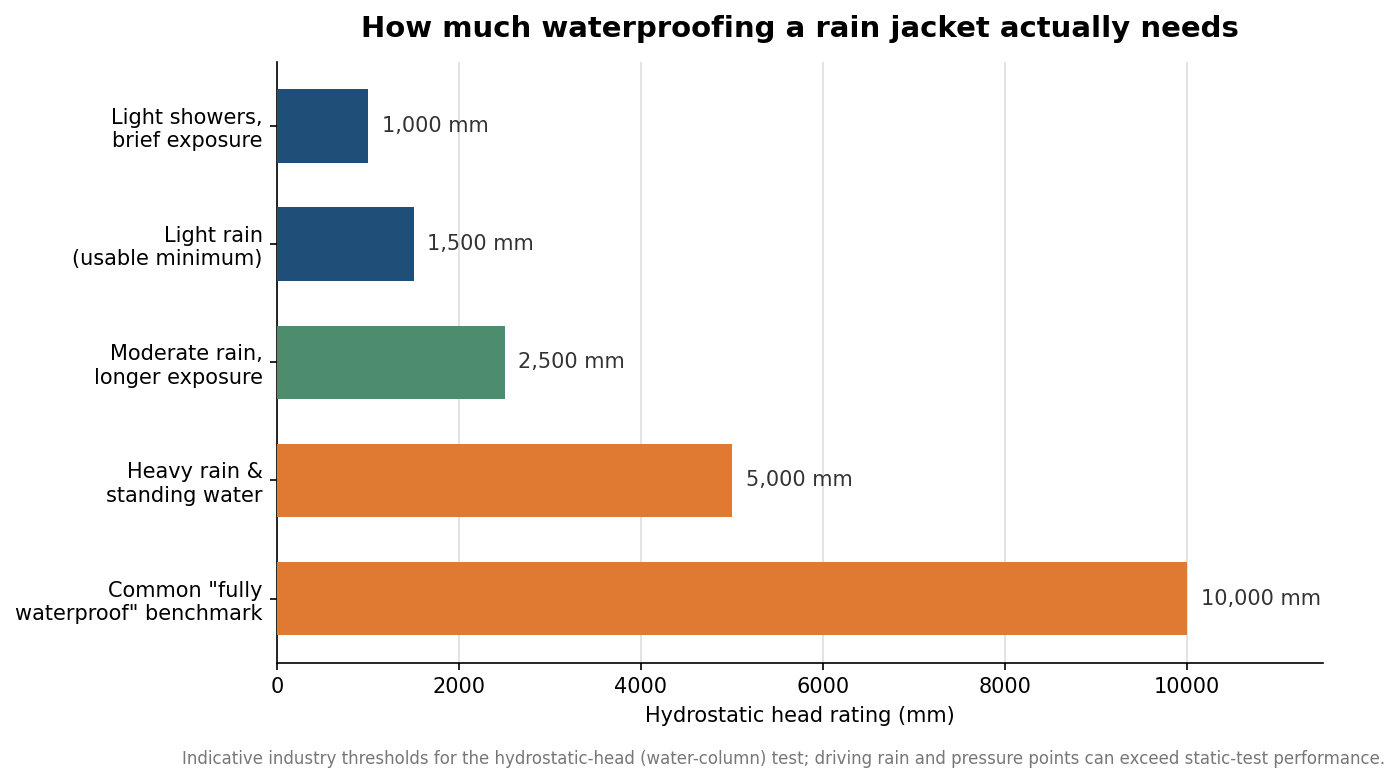
The number that matters most rarely appears on the product photo. Waterproofing is measured as hydrostatic head: the height of a water column, in millimeters, that a fabric can hold back before it starts to leak. As a rough industry guide, around 1,500 mm is the usable minimum to call a fabric waterproof for light rain. Ratings in the 2,000 to 3,000 mm band handle moderate rain and longer exposure, and 5,000 mm and above is where you get into genuinely heavy rain and standing water. Many outdoor shells are built to a 10,000 mm benchmark, which is comfortably more than a logo’d event jacket usually needs.
Match the rating to the job. A jacket handed out at a one-afternoon 5K does not need the same wall of protection as gear your grounds crew wears through a wet season. Two caveats are worth stating plainly: the hydrostatic-head test measures resistance to static pressure, so driving rain and pressure points like shoulders under a backpack strap can leak sooner than the lab number suggests; and very high waterproof ratings can trade away breathability, leaving you clammy from the inside even while staying dry from the outside.
Breathability is the companion spec, usually written as grams of water vapor passing through a square meter of fabric in 24 hours. Higher numbers move more sweat out. If people will be active in the jackets, a breathable membrane or vents matter as much as the waterproof rating; if the jacket is mostly for standing around in a drizzle, you can prioritize a lower price and a higher waterproof number instead.
Why embroidery and waterproofing fight each other
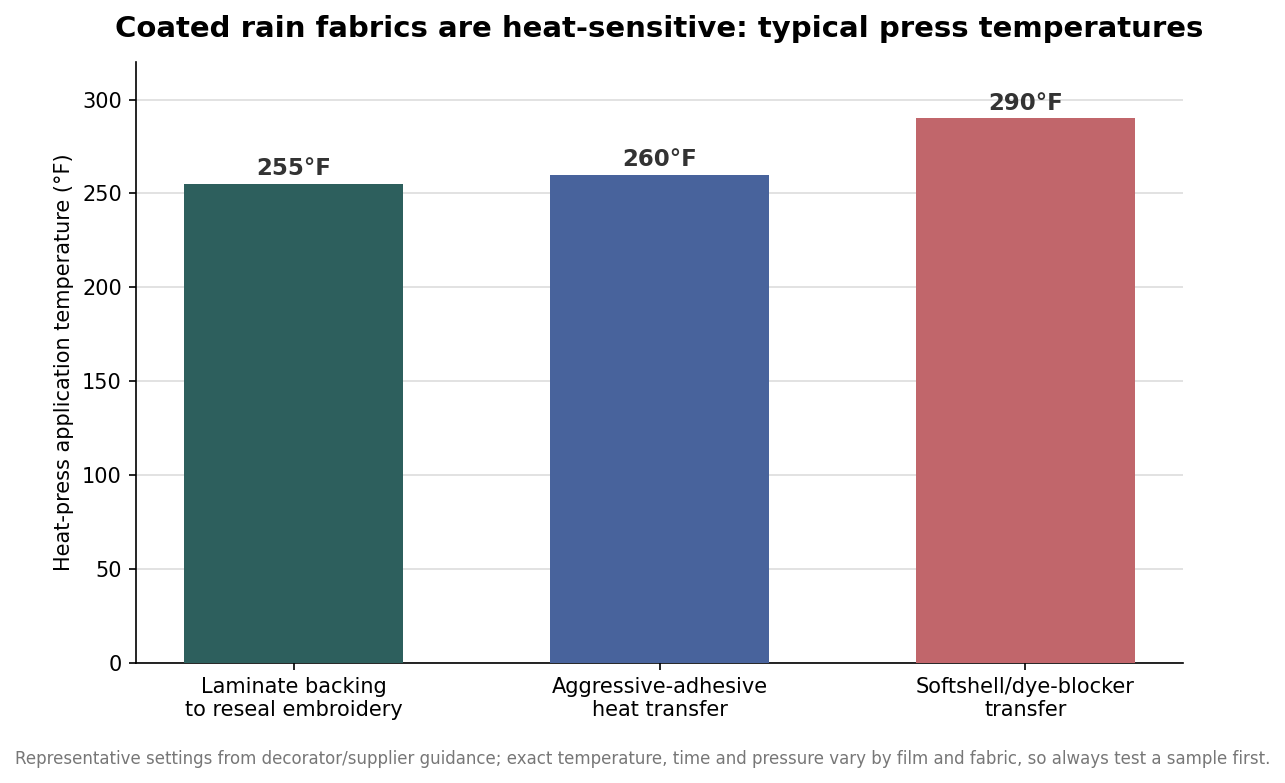
Embroidery looks premium, and on a fleece or a soft-shell it is a great choice. On a true waterproof shell it is a compromise, because stitching concentrates thousands of tiny needle holes into a small area and each one is a potential leak path through the coating or membrane. That does not make embroidery impossible, but it does mean the decorator has to do extra work. The common fix is to seal the back of the stitched area with a laminate film applied with heat, roughly 255°F for around fifteen seconds, so the interior side is closed back up. A small left-chest logo is far more forgiving than a large stitched back panel, simply because there is less perforated area to reseal.
If keeping the waterproof rating fully intact is the priority, the safer path is a decoration method that sits on the surface rather than punching through it. That is where heat-applied transfers and, in some cases, screen printing come in.
Heat transfer and screen printing on coated shells
Coated rain fabrics are heat-sensitive, which is the detail that trips up shops used to decorating cotton tees. The face of the fabric can scorch, gloss over, or discolor if the press is too hot or dwells too long, so temperature control is the whole game. Heat transfers succeed on nylon and polyester shells when the transfer uses an aggressive hot-melt adhesive built to grip coated surfaces; typical press temperatures land around 260°F, with dye-blocking softshell transfers running hotter, near 290°F, to stop the garment’s color from bleeding into the print. Screen printing is possible but fussier: the fabric can discolor during the flash-cure between colors, and plain inks may not bond to slick nylon without a catalyst or a two-part ink formulated for the substrate.
The practical takeaway is to test before you commit. A reputable decorator will run a sample on the exact jacket you plan to order and confirm that the adhesive holds, the color stays true, and the waterproofing survives. Woven or rubberized patches are a fourth option worth asking about; a heat-sealed patch can carry a detailed logo while limiting how much of the shell gets perforated or pressed.
Fabric, seams, and the details that decide comfort
Most branded rain jackets are built from a polyester or nylon shell with a polyurethane (PU) or thermoplastic polyurethane (TPU) coating on the inside and a durable water repellent (DWR) finish on the face that makes rain bead up and roll off. The DWR wears down with use and washing and can be revived with a spray-on or wash-in treatment, which is worth mentioning to anyone who expects the jacket to last several seasons. The other detail that separates a jacket that keeps you dry from one that merely looks like it will is seam sealing: fully taped seams cover the needle holes left by construction stitching, while untaped seams can wick water even when the fabric itself is rated well.
Weight and packability are the comfort levers. A lightweight packable nylon shell folds into its own pocket and suits giveaways and travel, while a heavier three-layer shell feels more durable and less like a plastic bag but costs more and ships bulkier. Fit runs large when jackets are meant to layer over a hoodie or uniform, so confirm whether you want a trim retail cut or a roomier team fit before you lock in sizes.
Quantities, lead times, and budgeting
Custom outerwear behaves differently from custom tees on minimums and price. Embroidery and heat-transfer setups often run at low minimums, sometimes a dozen pieces or fewer, while multi-color screen printing usually wants a larger run to justify the screen setup. Services advertising “no minimum” exist, but the per-unit price climbs steeply at ones and twos because the setup cost is spread across fewer jackets. As an indicative range rather than a quote, blank waterproof jackets commonly sit in the tens of dollars each, and a decorated logo rain jacket often lands anywhere from the low-$30s to $90 or more depending on the fabric, the features like taped seams and vents, the decoration method, and the quantity.
Lead times typically run about one to three weeks for a standard decorated order once artwork is approved, with rush options available at a premium; plan for longer if a specific jacket model has to be sourced or if you need pre-production samples. When you brief a supplier, give them four things up front: the waterproof rating you need, the decoration method and logo placement, the quantity and size breakdown, and your in-hand date. Those four answers let a decorator tell you immediately whether your logo choice and your waterproofing goal can coexist, or whether one of them needs to bend.
Branding a rain jacket is not hard, but it rewards deciding in the right order: pick the protection level the job actually calls for, then choose a decoration method that respects it. Do that, and you end up with jackets that carry your name and still do the one thing a rain jacket is bought to do.
Win Free Stuff
Enter below for a chance to win plus receive 10% off your first order.
🎉 You are in!
Check your email for your 10% off code. Good luck!