The spec sheet on a rain jacket comes down to two numbers and a short list of construction terms. When you are ordering custom jackets in quantity for a crew, an event, or your own shelves, reading those numbers correctly is the difference between gear people actually reach for when it is pouring and a stack of jackets that get left in the car. Here is what the ratings mean and how to match them to the job.
The waterproof number: hydrostatic head
Hydrostatic head is the headline waterproof figure, measured in millimeters. The test seals fabric under a column of water and records how tall that column gets before water is forced through, so a higher number means the fabric resists more pressure before it leaks. As a rough industry map, around 1,500mm is the common floor for a fabric to be called waterproof at all; roughly 5,000mm handles light rain, 10,000mm light-to-average rain, 15,000mm moderate rain, and 20,000mm and up covers heavy rain and higher pressure.
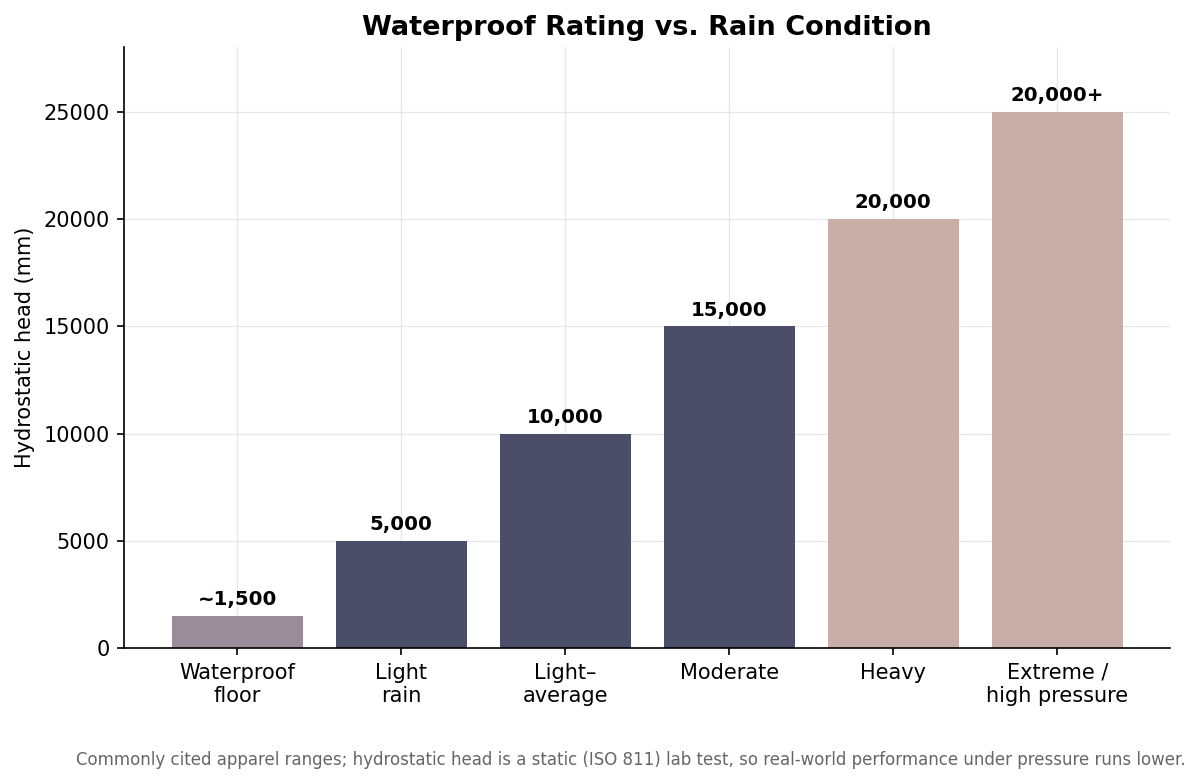
The important caveat is that this is a static laboratory measurement. Real weather adds dynamic pressure, driving rain, a backpack strap pressing on your shoulders, the simple act of kneeling or sitting on a wet surface, and under that pressure the effective waterproofing runs lower than the lab figure suggests. The practical move is to buy a margin above the minimum for the conditions rather than ordering right at the edge.
The comfort number: breathability
Waterproofing keeps rain out; breathability lets your own sweat vapor get out, and it is measured as moisture vapor transmission in grams per square meter over twenty-four hours. Higher numbers move more vapor. Commonly used bands put anything under about 5,000 in the low range, 5,000 to 10,000 as moderate, 10,000 to 15,000 as good, 15,000 to 20,000 as high, and 20,000 and above as very high.
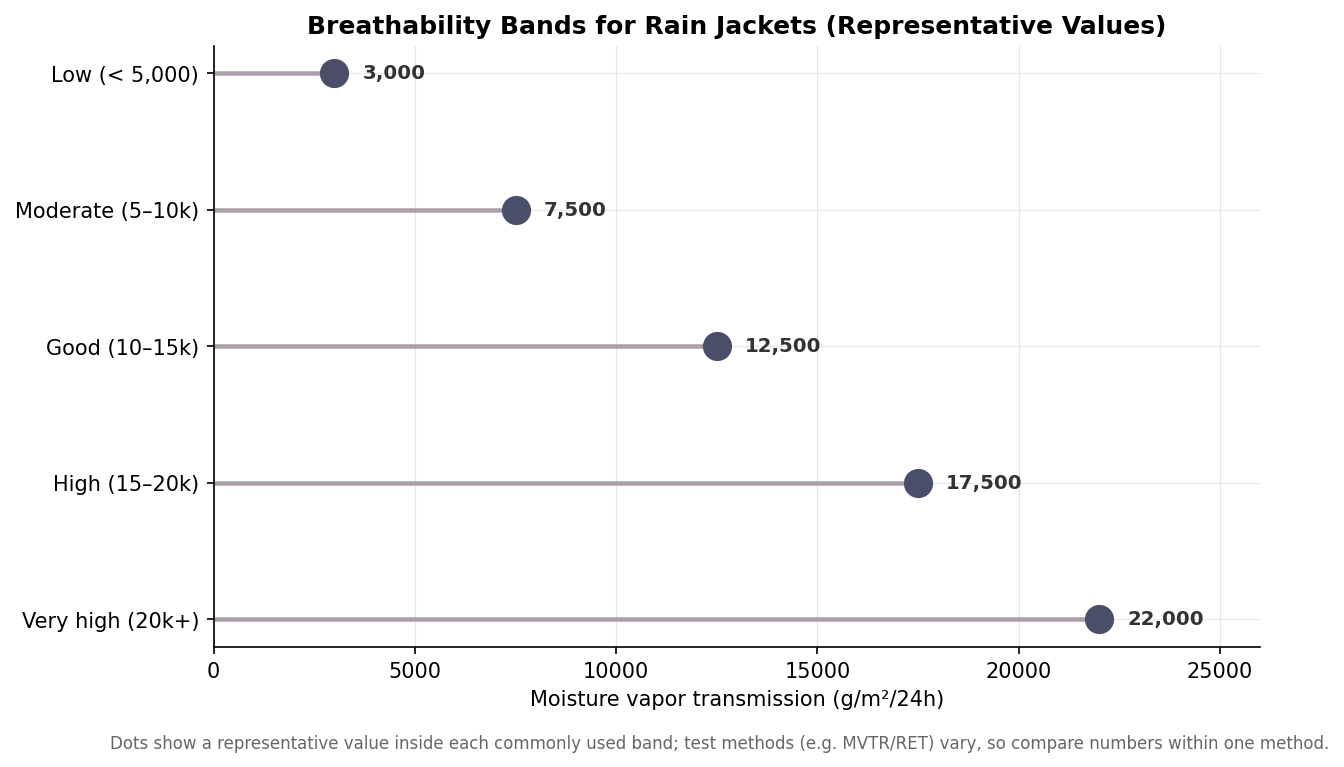
Breathability is the spec people forget and then complain about. A cheap non-breathable shell keeps the rain off and traps sweat against the body, so the wearer feels clammy within minutes and blames the jacket. For anyone active in the jacket, event staff on their feet all day, warehouse and yard crews, anyone hiking or working outdoors, breathability matters as much as the waterproof rating. For a jacket that mostly lives in a bag for the occasional shower, you can weigh it less.
How the jacket is actually built
Fabric becomes waterproof in one of two broad ways. A coating, typically polyurethane, is applied to the inside of the face fabric; it is inexpensive and reliable but generally less breathable. A membrane is a thin laminated film with microscopic structure that blocks liquid water while letting vapor pass; it costs more and breathes better. On top of either sits a durable water repellent (DWR) finish, a surface treatment that makes water bead and roll off the outer face. DWR is not permanent, it wears away with abrasion and washing, and it is restored with a wash-in or spray-on reproofer, which is worth telling recipients so their jackets keep performing.
Then there are the seams, which is where water-resistant and truly waterproof jackets part ways. Every stitched seam is a line of needle holes, and on a water-resistant jacket those holes let water wick straight through even when the fabric itself does not fail. A waterproof jacket seals them, either with heat-applied seam tape over the stitching or with welded seams that bond the panels without a needle at all. When a jacket is marketed as water-resistant rather than waterproof, unsealed seams are usually the reason.
Matching the rating to the use
Overbuying wastes budget and overweights the jacket; underbuying leaves people wet. For a giveaway or occasional-use jacket, a lightweight packable shell in the 5,000mm range with taped seams sheds showers, packs small, and carries a logo well. For staff who are outdoors through a full shift, step up to roughly 10,000 to 15,000mm with genuine breathability so they stay dry without cooking. For sustained, harsh exposure, utilities work, marine settings, ski operations, look for 20,000mm and up with welded seams. A 25,000mm mountaineering-grade shell is simply wasted money as a company-picnic giveaway, and a 3,000mm novelty jacket is a false economy for a road crew.
Fit belongs in the same decision. A jacket meant to layer over a hoodie or a hi-vis vest needs to be cut generously enough to close over that bulk, so for a team order it is worth requesting a size run of samples and letting people try them on before you lock quantities. Ordering a full curve from small through the largest sizes your group actually needs, rather than defaulting to a wall of mediums, is what keeps the finished jackets in rotation instead of in a drawer.
What to confirm before you order
Before committing to a run, ask the supplier for the hydrostatic head figure in millimeters rather than the word waterproof alone, and ask whether the seams are untaped, taped, or welded, since that single detail separates a jacket that holds up from one that leaks at the shoulders. If the jackets are for active wear, ask for the breathability number too. Confirm whether the fabric carries a DWR finish and how it is reproofed. Above all, get one physical sample and run a simple spray test before you approve hundreds of units; a five-minute test on the actual fabric tells you more than any line on a spec sheet. The figures here are typical industry ranges rather than fixed guarantees, and test methods differ between mills, so compare numbers that were measured the same way and verify the specifics with your supplier.